
Design · 9 min read
Fly It Proud, Fly It Right: Choosing an American Flag Built for Coastal Living
America’s 250th is July 4, 2026. Learn what separates a coastal-grade flag from a disposable one, how to size it for your Lowcountry home, and how to turn your porch display into a curated finishing touch.
01
Why Cheap Flags Fail on the Coast
A bargain flag from a big-box store might look fine on the Fourth. By Labor Day, it's a faded, fraying ghost of itself. That's not a quality-control issue – it's a materials issue. The Lowcountry's combination of salt air, intense UV, high humidity, and steady ocean breezes creates one of the most punishing environments for outdoor textiles in the United States. A flag that lasts three seasons in the Midwest might not survive one here.
Three things separate a coastal-grade flag from a disposable one:
02
How Salt Air Accelerates the Damage
If you've lived on Hilton Head Island or in Bluffton for any length of time, you know what salt air does to everything it touches. Metal corrodes. Wood grays. Paint fades. Your flag is no exception.
Airborne salt particles are abrasive at a microscopic level. When wind drives them into flag fabric at 10–15 mph for hours every day, they act like fine sandpaper – wearing down fibers, opening the weave, and accelerating UV damage. The combination of salt abrasion and UV exposure is why a flag that might last two years in Charlotte lasts six months on Hilton Head without proper construction.
This is exactly why buying a locally made, coastal-grade flag matters. Allegiance builds their flags in Charleston – they understand what the Lowcountry coast demands because they live in it. Their material choices and construction methods reflect that understanding.
03
Sizing Your Flag for Your Home
A flag that's too small looks timid. A flag that's too large overwhelms the architecture. Getting the size right is one of those details that separates a thoughtful display from an afterthought.
The general rule: the flag should be proportional to the display area. Here's how that translates to common Lowcountry home styles:
04
Placement, Height, and Angle
Where and how you mount your flag matters as much as the flag itself. A few guidelines:
Height: The flag should be high enough that it flies freely without touching railings, rooflines, or landscaping. For porch-mounted brackets, the bottom of the flag should clear the railing by at least 12 inches.
Angle: A 45-degree angle bracket is the most common for porch mounting. It projects the flag away from the house and allows it to catch the breeze naturally. Vertical mounts work for narrow spaces but produce less visual movement.
Visibility: Mount the flag where it's visible from the primary approach to your home – usually the street or driveway side. If your home faces the marsh or water, consider a second display on that side.
Lighting: Flag etiquette calls for illumination if you fly the flag at night. A small solar-powered spotlight aimed at the flag is the simplest solution – it adds a warm glow to your porch display and keeps the flag properly honored after dark.
05
When to Wash, When to Retire
Even a premium flag needs occasional care. Here's a simple maintenance guide:
Monthly rinse: Hose down your flag with fresh water to remove salt buildup. This is the single most effective thing you can do to extend its life on the coast. Salt left on the fabric accelerates fading and fiber breakdown.
Quarterly wash: Hand wash in cool water with mild detergent. Don't use bleach. Rinse thoroughly and air dry completely before re-flying. Never put a flag in the dryer.
Inspect monthly: Check the fly end for fraying, the grommets for corrosion, and the header for wear. Small repairs (re-stitching a frayed edge) can extend the flag's life significantly.
When to retire: When the stripes are noticeably faded, the fly end is frayed beyond repair, or the fabric has become thin and translucent, it's time. Retired flags should be disposed of respectfully – many VFW posts and American Legion chapters on Hilton Head Island and in Bluffton accept flags for proper retirement ceremonies.
With proper care, a premium Allegiance flag will fly beautifully for 12–18 months in full coastal exposure – significantly longer than the 3–4 months you'd get from a bargain flag. If your flag is mounted under a covered porch, expect even longer life.
06
The Porch Styling Angle: Flag as Finishing Touch
Here's where this goes from practical to inspired. A flag isn't just a standalone display – it's a design element that can complete the entire look of your porch or entryway.
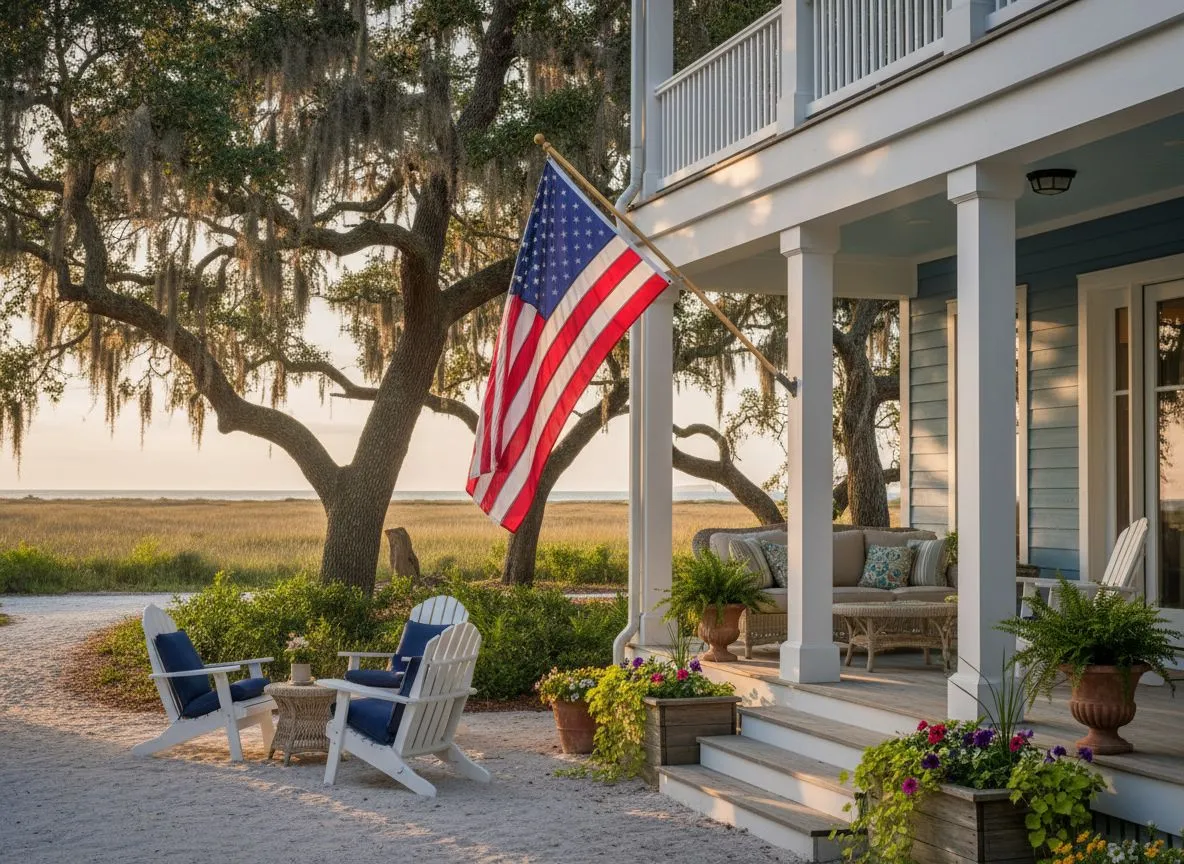
Think about it as a curated composition: the flag provides vertical drama and movement. The furniture anchors the space with comfort and style. Planters add natural texture and color. Together, they create an entryway that tells a story – one of pride, taste, and intention.
A few combinations that work beautifully:
Classic Lowcountry: An Allegiance flag on a white bracket, flanked by Berlin Gardens Adirondack chairs in coastal blue or white, with fern-filled planters on either side. Simple, timeless, unmistakably Southern.
Modern Coastal: A flag on a matte black bracket, paired with Lloyd Flanders all-weather wicker in a warm gray finish, with architectural planters in concrete or terracotta. Clean lines, warm textures, quiet sophistication.
Estate Entrance: A freestanding flagpole in the front yard, with Berlin Gardens deep-seating furniture on the porch and oversized planters framing the front door. Grand without being ostentatious.
The Renovation Visionary – the homeowner who's just finished a porch project or a full exterior renovation – often overlooks this final layer. The furniture is placed, the landscaping is done, but the porch still feels like it's missing something. A well-chosen flag, properly sized and mounted, is often exactly that missing piece. It adds movement, color, and a sense of pride that ties the whole composition together.
07
America's 250th: A Moment Worth Marking
July 4, 2026 isn't just another Independence Day. It's the semiquincentennial – America's 250th birthday. Every flag flying from a Hilton Head Island porch or a Bluffton front yard this summer carries a little extra weight, a little extra meaning.
If there was ever a year to invest in a flag that's built to last, sewn by American hands, and designed to fly proudly in the very conditions your home faces every day – this is it.
Allegiance Flag Supply makes that flag. Right here in Charleston, South Carolina. And we carry them at our showroom on Hilton Head Island.
08
Bring a Photo of Your Porch to the Showroom
We'll help you choose the right flag size, mounting style, and placement – and show you how to pair it with furniture and planters for a porch display that turns heads. Allegiance flags, Berlin Gardens furniture, and Lloyd Flanders wicker – all in one showroom on Hilton Head Island.
Products Featured in This Article
Keep Reading
You May Also Like
Ready to Create Your Outdoor Space?
Visit our showroom for personalized guidance on furniture, grills, and everything you need to live beautifully outside.
Schedule a Consultation