
Grilling · 13 min read
Big Green Egg vs. Napoleon vs. Weber vs. Delta Heat: Which Grill Brand Is Right for Your Hilton Head Home?
An honest, brand-by-brand comparison from an authorized dealer on Hilton Head Island — how each cooker performs in coastal conditions, what each one is genuinely best at, what it costs you in convenience, and how they fit into a Challenger outdoor kitchen.
01
Start With How You Cook, Not With the Brand
Almost everyone who walks into our Hilton Head Island showroom starts in the same place: "I've been reading about the Big Green Egg" or "my neighbor has a Napoleon." Those are fine starting points, but they're the wrong question.
The right question is: what does a normal week of cooking look like at your house?
Weeknight dinners in under thirty minutes for two people is a fundamentally different problem than a twelve-hour brisket, which is different again from a rental property where guests need something foolproof, which is different again from a custom outdoor kitchen you're building with a contractor next spring.
We carry Big Green Egg, Napoleon, Weber, and Delta Heat — plus Challenger outdoor kitchens to put them in — because those four cover the range of ways people actually cook here. What follows is how we'd talk you through it in person, including the parts that are less flattering to each brand. If you'd rather answer a few questions and get a starting point, our outdoor living quiz does the same triage.
02
The Coastal Filter: What Hilton Head Does to a Grill
Before brands, understand the environment, because it eliminates options that would be perfectly fine in Charlotte.
Salt air is the dominant factor. Airborne salt is corrosive and it is constant — closer to the beach it's severe, and even mid-island homes see it. It attacks welds, fasteners, burner tubes, and thin-gauge stainless. Add year-round humidity, intense UV, and the pollen-and-storm cycle, and you have a genuinely hostile environment for outdoor appliances.
Practical consequences we see every season:
Grade of stainless matters more than the amount of it. "Stainless steel" is not one material. Higher grades (304 and similar) resist coastal corrosion substantially better than the lower-grade steel common in budget grills. A big-box grill with a lot of shiny steel can be showing rust bloom within a season here while a well-built grill looks new after five.
Fasteners and small parts fail first. Screws, clips, igniter components, and hinges are where corrosion shows up before the body ever does.
Covers are not optional on the coast. They're the cheapest life-extension available.
Ceramic sidesteps the problem entirely. This is a real, underrated advantage of a kamado in this climate.
This is also why we don't stock everything. A grill has to earn its place on our floor by surviving what our customers' patios do to it.
03
Big Green Egg: Maximum Versatility, Maximum Involvement
What it is: A ceramic kamado cooker running on lump charcoal. Grill, smoke, bake, roast, sear — one unit, wide temperature range.
What it's genuinely best at: Everything slow, and everything hot. Low-and-slow barbecue with real smoke flavor; pizza at 600°F+; a hard sear; overnight cooks that hold temperature without babysitting. The ceramic's insulation is what makes both ends of the range possible on the same cooker.
Coastal verdict: The most weather-indifferent grill we sell. Salt has almost nothing to attack. Maintain the bands, hinge, and gasket and it will outlive several gas grills.
The honest tradeoffs: You light a fire. Realistically that's 15–20 minutes before you're cooking, plus a learning curve on airflow control for the first few cooks. It's heavy — moving one is a two-person job. And it's a single cooking chamber: you cannot run a 225°F smoke and a 550°F sear at the same time.
Buy it if: You enjoy the cooking as much as the eating, you smoke or bake outdoors, or you want one cooker that does the widest possible range of things. Our full EGG buyer's guide covers sizing and accessories in depth.
Skip it if: Your outdoor cooking is mostly weeknight convenience and you'll resent a fire.
04
Napoleon: Gas Performance and Serious Searing
What it is: Premium gas grills, freestanding and built-in, known for infrared searing technology, multi-zone burner layouts, and the signature blue-lit control knobs.
What it's genuinely best at: High-heat searing on a gas grill — the infrared sear station gets you steakhouse crust without lighting charcoal. Napoleon also does multi-zone cooking well, which matters when you're running vegetables, chicken, and steaks on different heat at the same time for a crowd.
Coastal verdict: Strong. Well-built stainless construction that stands up to island conditions when it's covered and rinsed. The lit knobs are a small thing that people love more than they expect — most entertaining here happens after dark.
The honest tradeoffs: More moving parts than a kamado means more that can eventually need service — igniters, valves, burners. It is not a smoker; you can approximate smoke, but it's not what it's for. And the feature set means there's a model-and-configuration decision to make, which is genuinely easier in person than online.
Buy it if: You want convenience and real searing power, you cook for a group with varied requests, or you want a capable built-in for an outdoor kitchen.
05
Weber: Proven, Predictable, and Easy to Live With
What it is: The most recognized name in grilling, from the classic kettle up through the premium Summit series, across gas, charcoal, and pellet.
What it's genuinely best at: Being reliable and unfussy. Weber's engineering is conservative in the best sense — things work, parts are available everywhere, and the accessory ecosystem is enormous. The premium Summit models add rotisserie, sear station, and refined build without changing that character.
Coastal verdict: Good, with a caveat worth stating plainly: Weber spans a huge price and quality range. The premium end holds up well here. The entry-level end is built to a price point that coastal conditions will find. Buying "a Weber" on Hilton Head is not one decision — which Weber matters a great deal.
The honest tradeoffs: At the premium end you're paying for a well-known name, and some competitors deliver more raw searing capability per dollar. It's the least distinctive choice on this list — which for many households is exactly the appeal.
Buy it if: You want something proven and easy, you're outfitting a rental or second home where guests need to figure it out without instructions, or you want the deepest parts-and-accessories availability of any brand here.
06
Delta Heat: The Built-In Answer
What it is: Professional-grade built-in gas grills engineered by the Twin Eagles team in California — built-in performance at a more accessible price than the flagship professional lines.
What it's genuinely best at: Being installed. If your project is an outdoor kitchen — Challenger island or custom masonry — Delta Heat is built for that from the start: clean face, proper cutout dimensions, materials specified for permanent outdoor installation.
Coastal verdict: Very strong. This is a grill designed to live outdoors permanently, which is precisely the coastal use case. American-made, with the build quality to justify a built-in commitment.
The honest tradeoffs: It's not the choice if you want to roll a grill around the deck. Built-in also means you should get the design right the first time — cutout, gas line, clearances, and access panels are decisions that are expensive to revisit. That's exactly the conversation we have with homeowners and their builders before anything is ordered; our outdoor kitchen planning guide covers what to decide up front.
Buy it if: You're building an outdoor kitchen and want a grill engineered for the job rather than a freestanding unit adapted to it.
07
Where Challenger Fits: The Island, Not the Grill
Worth clearing up, because it's the most common confusion we hear: Challenger doesn't make the grill — Challenger makes the kitchen the grill lives in.
Challenger builds modular outdoor kitchen islands from powder-coated aluminum in Indiana, with shaker-style doors and real storage. Two things make them the answer for a lot of Lowcountry homes:
Aluminum doesn't rust. Not "resists rust" — the material itself doesn't corrode the way steel does. On a salt-air patio, that's the whole argument.
It arrives finished. A custom masonry outdoor kitchen is a construction project with permits, a contractor, and a timeline measured in weeks or months. A Challenger island is delivered, placed, and used. For seasonal residents and anyone who wants the space usable this year, that difference decides it.
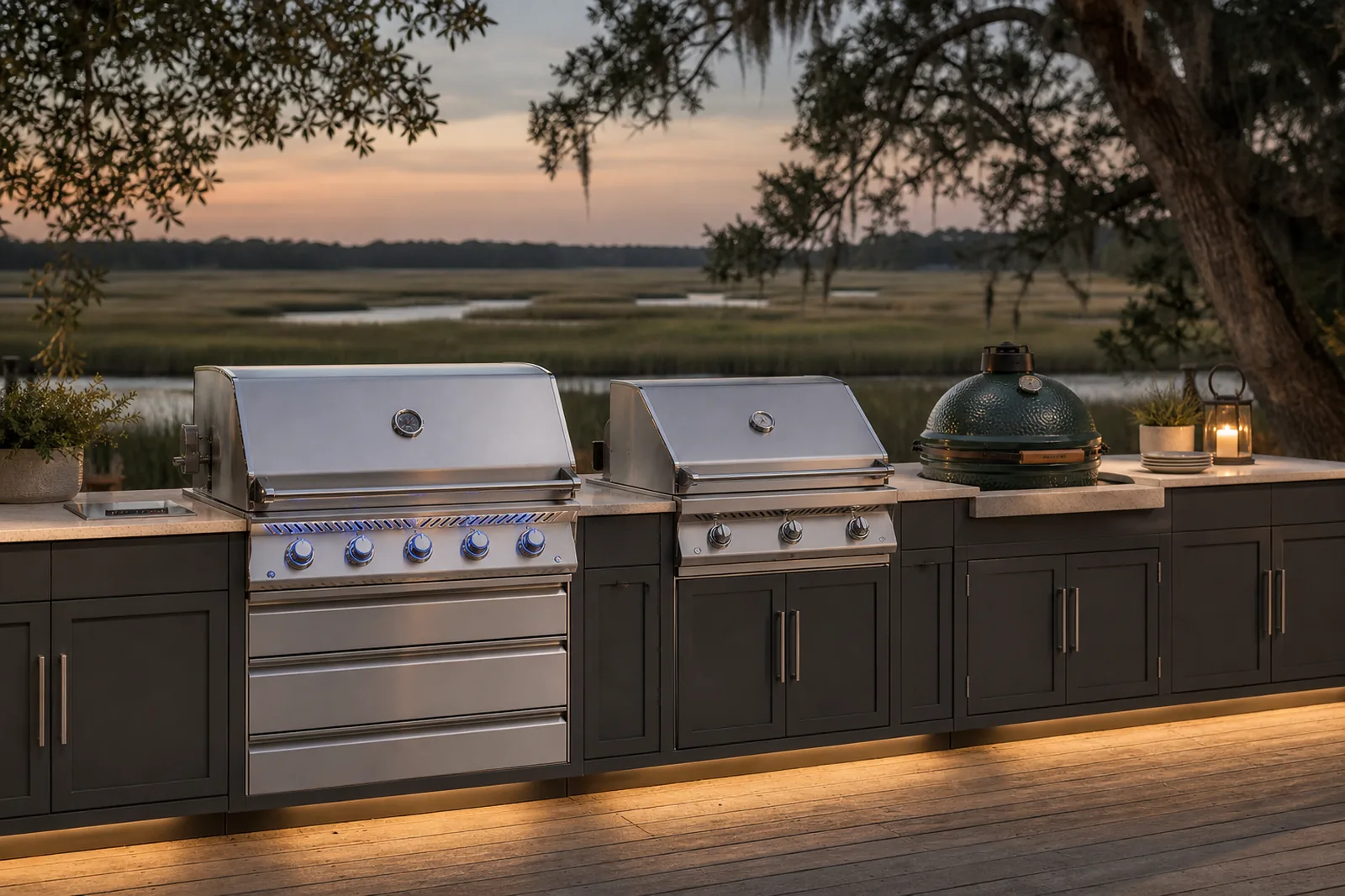
Challenger islands accept Delta Heat and Napoleon built-in grills, and there's a configuration designed to seat a Big Green Egg at counter height. That's why nearly every grill in our showroom is displayed in a Challenger island — it's how they end up living on real patios here, and it's what we recommend when someone asks what to set their new grill into.
08
The Short Version: Matching Brand to Household
"I want one cooker that does everything, and I like the ritual." → Big Green Egg, Large.
"I want great steaks on a weeknight with no fuss." → Napoleon with the infrared sear station.
"I want proven and simple, and other people will use it." → Weber, premium series.
"I'm building an outdoor kitchen." → Delta Heat built into a Challenger island.
"I do both — quick weeknights and weekend projects." → A gas grill plus an EGG, side by side in a Challenger run. This is genuinely the most common setup among serious outdoor cooks on the island, and it's why our display is built that way.
"I have a villa balcony or very limited space." → A Big Green Egg MiniMax or Small, or a compact freestanding gas grill. Check your community's rules before you buy — several Hilton Head regimes restrict open-flame cooking on balconies and upper decks.
09
Questions We Get Asked Every Week
Which grill lasts longest in Hilton Head's salt air? A ceramic kamado, by construction — there's very little for salt to corrode. Among gas grills, the deciding factor is the grade of stainless and the quality of the fasteners, not the brand name on the lid. That's the specific thing to compare when you shop.
Gas or charcoal for coastal cooking? It's a lifestyle question, not a climate one. Gas wins on weeknights and for guests; charcoal and ceramic win on flavor, temperature range, and slow cooking. Plenty of households here own both, which is why outdoor kitchen runs with two cookers are so popular.
Can I put any of these grills into an outdoor kitchen? Built-in models from Delta Heat and Napoleon are designed for it, and Big Green Egg has a purpose-built island configuration. Freestanding grills should not be enclosed in cabinetry that wasn't designed for them — it's a clearance and safety issue, not a style one. Bring us your plans and we'll spec it properly.
How much should I expect to spend? Premium grills cover a wide range depending on size, fuel, and whether you're going built-in — and outdoor kitchen cabinetry is its own line item. We'd rather quote you honestly against your actual configuration than publish a number that turns out not to apply. Call the showroom at (843) 715-0927 or come in and we'll price the real setup.
Do you service what you sell? Yes. We're an authorized dealer for Big Green Egg, Delta Heat, and Challenger, we deliver and set up throughout Hilton Head Island, Bluffton, and Beaufort County, and we stock the parts people actually need. Buying local is the difference between a phone call and a support ticket when something needs attention.
Can I see these side by side? That's the point of our showroom at 13 New Orleans Road. Every brand above is on the floor, installed in Challenger islands the way they'd live on your patio. Open the lids, feel the build, ask us what we'd put in our own backyards.
Keep Reading
You May Also Like
Grilling · 12 min read
The Big Green Egg on Hilton Head: A Complete Buyer's Guide from an Authorized Dealer
Grilling · 8 min read
Building a Big Green Egg Outdoor Kitchen: Islands, Cooking Stations and Built-In Kamado Setups
Grilling · 7 min read
Big Green Egg vs. Traditional Grills: Why Kamado Reigns Supreme
Ready to Create Your Outdoor Space?
Visit our showroom for personalized guidance on furniture, grills, and everything you need to live beautifully outside.
Schedule a Consultation