
Grilling · 10 min read
Buying a Grill on Hilton Head Island: A Local Store Guide for Coastal Grilling
Salt air destroys cheap grills in a single season. This guide covers what to look for when buying a grill on Hilton Head — from material grades to fuel types to outdoor kitchen integration with Challenger cabinetry.
01
The Coast Eats Cheap Grills Alive
If you've lived on Hilton Head Island for more than a year, you've probably watched a grill die. The chrome-plated grates rust through. The painted steel firebox develops holes. The ignition system corrodes and stops clicking. What started as a perfectly adequate grill on a showroom floor somewhere becomes an eyesore on your patio — and it happens faster here than almost anywhere else in the country.
The culprit is salt air. Hilton Head sits directly on the Atlantic coast, and airborne salt particles are constantly at work on every piece of exposed metal in your outdoor space. Add intense UV exposure, humidity that hovers between 70% and 90% for most of the year, and occasional tropical storms, and you have one of the most punishing environments for outdoor cooking equipment in the United States.
This is why buying a grill on Hilton Head is fundamentally different from buying one in the suburbs of Charlotte or Atlanta. A grill that lasts eight years inland may not survive two seasons here without the right materials and construction. Knowing what to look for — and buying from a store that understands these conditions firsthand — is the difference between a decade of great cooking and a frustrating cycle of replacement.
02
Understanding Your Fuel Options
Before you evaluate specific brands, start with the fundamental question: how do you want to cook?
Gas grills offer convenience and speed. Turn a knob, press the igniter, and you're grilling in under ten minutes. Temperature control is precise and immediate — turn the burner up or down and the heat responds instantly. Gas excels at weeknight dinners, quick sears, and multi-zone cooking where you need different temperatures across the cooking surface simultaneously.
On Hilton Head, the key variable is build quality. Gas grills range from $300 disposable units to $5,000 built-in systems, and the difference isn't just features — it's durability. Lower-end gas grills use thin-gauge steel and chrome-plated components that corrode rapidly in salt air. Premium gas grills use 304 stainless steel, which contains chromium and nickel for genuine corrosion resistance.
Napoleon's Prestige and Prestige PRO lines are built with this coastal reality in mind. The Prestige PRO series features infrared sear stations that reach temperatures above 1,000°F — enough to develop a steakhouse-quality crust in under 90 seconds. The signature blue-lit control knobs aren't just aesthetic; they make low-light cooking practical when you're grilling at dusk. Every Napoleon grill we carry uses 304 stainless steel for critical components.
Twin Eagles occupies the premium tier — handcrafted stainless steel grills designed for serious outdoor kitchens. The fit and finish on a Twin Eagles grill is immediately apparent the moment you lift the lid. The C Series delivers exceptional heat distribution and retention, while the Eagle One represents the pinnacle of residential grilling technology with ceramic briquette trays, hexagonal cooking grates for maximum sear marks, and a build quality that borders on commercial.
Weber's Summit series has earned its reputation through decades of reliable performance. The Summit features include a dedicated sear station, a built-in smoker box, and the Snap-Jet individual burner ignition system that eliminates the most common failure point in coastal grills — the ignition system. Weber's Genesis line offers the same build philosophy at a more accessible price point.
Kamado grills are ceramic cookers that do everything. The Big Green Egg is the most recognized kamado in the world, and its ceramic construction makes it uniquely suited for Hilton Head. Ceramic doesn't corrode. There's no electronic ignition to fail in humidity. The body will outlast your deck, your house, and possibly your mortgage.
The Big Green Egg's secret is thermal mass. Its thick ceramic walls absorb heat and radiate it back evenly, creating a cooking environment that can hold 225°F for a 14-hour brisket smoke or climb to 700°F for Neapolitan pizza — all in the same cooker, controlled by two simple airflow vents. It's the most versatile cooking tool you can own outdoors.
03
The Outdoor Kitchen Question: Why Challenger Changes the Equation
If you're considering a built-in grill — or if you've ever thought about a permanent outdoor cooking station — you need to understand what Challenger Designs is doing with modular outdoor kitchens.
Traditional outdoor kitchens are custom masonry or concrete projects. They require contractors, permits, weeks of construction, and budgets that start at $15,000 and climb quickly. They're permanent — once it's built, you can't reconfigure it, move it, or take it with you.
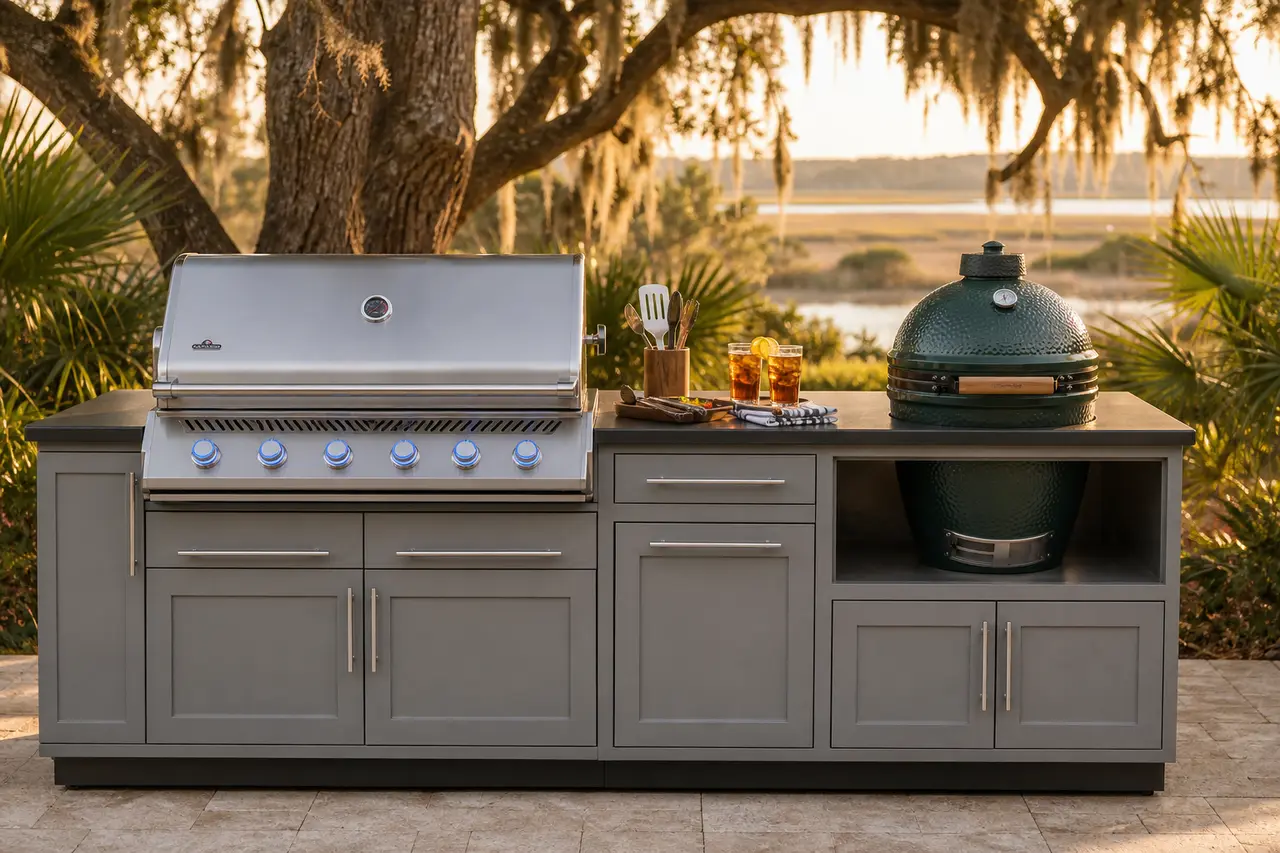
Challenger's modular cabinetry takes a completely different approach. Their Coastal Collection is built from powder-coated aluminum — the same material used in marine and aircraft applications. The cabinets are modular, meaning you can configure an island for any combination of grills, storage, and accessories. They arrive fully assembled, connect together, and create a finished outdoor kitchen in hours instead of weeks.
The quality is immediately apparent. Shaker-style cabinet doors with stainless bar-pull handles. Composite countertops that resist heat, stains, and UV fading. Adjustable stainless steel feet for leveling on any surface. The cabinetry comes in multiple finishes — warm gray, charcoal, and white — that complement virtually any Lowcountry home exterior.
What makes Challenger particularly compelling is compatibility. A single Challenger island can house a Napoleon Prestige PRO built-in grill on one side and a Big Green Egg in a dedicated cutout on the other. You can pair a Twin Eagles gas grill with a kamado and have both fuel types in one cohesive kitchen. Add storage cabinets, trash pullouts, and access doors, and you have a complete cooking station that rivals custom masonry — at a fraction of the cost and timeline.
For Hilton Head homeowners, the modular design has another advantage: portability. If you renovate your outdoor space, move to a new home, or want to reconfigure your layout, Challenger cabinets move with you. That's not true of a $30,000 masonry island.
04
What to Look for When You're Standing in Front of a Grill
Shopping for a grill is a physical experience. Here's what to actually evaluate when you visit a showroom.
Lift the lid. A quality grill lid should feel substantial and move smoothly on its hinges. If it rattles, flexes, or feels like it might pull off, the construction quality isn't there. The lid is the largest single component and the best indicator of overall build quality.
Check the grates. Cast iron grates hold heat beautifully and create excellent sear marks, but they require seasoning and maintenance — especially in salt air. Stainless steel grates are lower-maintenance and resist corrosion better. Some premium grills use heavy-gauge stainless rod grates that combine the heat retention of cast iron with the corrosion resistance of stainless.
Inspect the burners. Stainless steel burners last longer than aluminized steel burners in coastal conditions. Look for individually ignited burners — if one igniter fails, the others still work independently. Napoleon's individual ignition system and Weber's Snap-Jet system both address this.
Test the ignition. Click the igniter several times. It should fire consistently, with a strong, reliable spark. Ignition failure is the most common maintenance issue with gas grills on the coast, and it's directly related to igniter quality and moisture resistance.
Open the doors and drawers. If the grill has a cabinet base, check the door alignment, hinge quality, and interior construction. Cheap cabinet grills use thin sheet metal that warps over time. Quality cabinets use the same grade of materials as the grill itself.
Ask about the warranty. Premium grill brands offer component-specific warranties — often 10 years or lifetime on the firebox and frame, with shorter warranties on burners and ignition. A good warranty reflects the manufacturer's confidence in their materials.
05
Coastal Grilling: Maintenance That Extends the Lifespan
Even premium grills need care on Hilton Head. The difference is that a well-built grill responds to maintenance, while a cheap grill degrades regardless.
Monthly: Rinse the entire exterior with fresh water to remove salt deposits. This is the single most important thing you can do. Salt left on stainless steel accelerates pitting and staining. A quick garden hose rinse takes two minutes and prevents hundreds of dollars in cosmetic damage.
After every cook: Burn the grates clean at high heat for five minutes, then brush with a quality grill brush. For cast iron grates, wipe with a thin coat of cooking oil after brushing. For the Big Green Egg's ceramic interior, simply close the vents after cooking — the retained heat will burn off residue naturally.
Seasonally: Check all gas connections for leaks using soapy water. Inspect burner ports for blockages — spiders love building nests in burner tubes during South Carolina's warm months. Replace any rusted or deteriorated components before they affect cooking performance.
Cover your grill. A quality grill cover blocks salt air, UV exposure, and moisture when you're not cooking. Every brand we carry sells purpose-built covers. This is not optional on Hilton Head — it's essential maintenance.
06
The BTU Myth and Other Specifications That Don't Matter
Grill marketing loves to tout BTU output as a measure of power. Higher BTUs means more heat, right? Not necessarily.
BTUs measure fuel consumption, not cooking performance. A grill that uses more gas isn't automatically hotter — it might just be less efficient. What matters is heat retention: how well the grill holds temperature at the cooking surface. A well-insulated grill with thick-gauge construction delivers better cooking performance at lower BTU ratings than a thin-walled grill with impressive BTU numbers.
Similarly, total cooking area is often misleading. A grill might advertise 800 square inches of cooking space, but if that includes a warming rack you'll never use and a secondary zone with poor heat distribution, the usable area is much smaller.
The specifications that actually matter for coastal grilling: material grade (304 vs 430 stainless steel, or ceramic for kamado), construction thickness (thicker gauge = better heat retention and durability), and the ignition system quality.
07
Gas vs. Kamado: Do You Need to Choose?
The most common question we hear at Terrace + Tide is whether to buy a gas grill or a Big Green Egg. The honest answer: if your space and budget allow it, own both.
Gas and kamado are complementary, not competitive. Gas excels at quick weeknight dinners, high-heat searing, and multi-zone cooking. The Big Green Egg excels at low-and-slow smoking, wood-fired pizza, bread baking, and anything that benefits from ceramic heat retention and natural charcoal flavor.
With a Challenger outdoor kitchen, you can house both in a single island — a Napoleon or Twin Eagles gas grill on one side and a Big Green Egg in a dedicated cutout on the other. It's the best of both worlds in a cohesive, attractive package.
If you're starting with one and plan to add the other later, we generally recommend starting with whichever matches your primary cooking style. If you grill three times a week and want convenience, start with gas. If you love the craft of cooking and want maximum versatility, start with the Egg.
08
Why Buying Local Matters for a Grill
A grill purchased from a local store on Hilton Head comes with something you can't get online: ongoing support from people who understand your environment.
We've assembled every grill we sell. We've cooked on them. We know which accessories are essential and which are marketing fluff. When a customer calls with a maintenance question or a warranty issue, we handle it — no call center, no ticket number, no waiting for a callback.
We also know what works on the coast. Our recommendations aren't based on national sales data or manufacturer incentives. They're based on years of seeing what holds up in Hilton Head's specific conditions and what doesn't.
Visit our showroom at 71 Lighthouse Road to see Napoleon, Twin Eagles, Weber, Big Green Egg, and Challenger outdoor kitchens — all assembled, all available to evaluate in person. Bring your questions. We'll help you find the right setup for how you actually cook.
09
Frequently Asked Questions
How long do grills last on Hilton Head Island? With proper maintenance and quality construction, a premium gas grill lasts 10-15 years on Hilton Head. A Big Green Egg's ceramic body is virtually indestructible — many Eggs are still cooking after 20+ years. Budget grills typically last 1-3 seasons in salt air conditions.
What's the best grill material for salt air? Ceramic (Big Green Egg) is completely impervious to salt air corrosion. For gas grills, 304 stainless steel is the gold standard — it contains nickel for superior corrosion resistance. Avoid chrome-plated or painted steel components in coastal environments.
Should I get a built-in grill or a freestanding grill? It depends on your outdoor space and long-term plans. Built-in grills with Challenger cabinetry create a polished outdoor kitchen look and offer more storage and prep space. Freestanding grills are more portable and require less initial investment. Both work well — the choice is about lifestyle and space design.
How much does a good grill cost? Premium freestanding gas grills range from $1,500 to $4,000. Built-in models range from $2,500 to $6,000. A Big Green Egg Large with a nest and accessories runs $1,500-$2,000. A Challenger outdoor kitchen island configured with a built-in grill and Egg starts around $5,000-$8,000. These prices reflect materials that actually survive on the coast.
Can I convert a natural gas grill to propane or vice versa? Most premium brands offer conversion kits, and many models are available in either fuel type from the factory. Weber, Napoleon, and Twin Eagles all support both fuel types. If you have natural gas plumbed to your patio, a natural gas grill eliminates tank refills entirely.
Products Featured in This Article
Keep Reading
You May Also Like
Grilling · 12 min read
The Big Green Egg on Hilton Head: A Complete Buyer's Guide from an Authorized Dealer
Grilling · 8 min read
Building a Big Green Egg Outdoor Kitchen: Islands, Cooking Stations and Built-In Kamado Setups
Grilling · 7 min read
Big Green Egg vs. Traditional Grills: Why Kamado Reigns Supreme
Ready to Create Your Outdoor Space?
Visit our showroom for personalized guidance on furniture, grills, and everything you need to live beautifully outside.
Schedule a Consultation